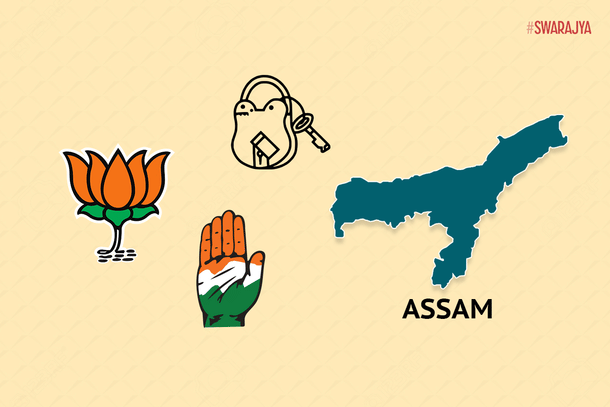
Assam is one of India's northeastern state, which forms an integral part of the 7 sisters groupinf. The state of Assam goes to vote in 2026, with the incumbent BJP led NDA alliance being on the one side, while having the Congress led Mahajot as the key opposition. BJP currently has Asom Gana Parishad (AGP), Bodo People's Front (BPF) and UPPL as its allies, while, the Mahajot has Left front and Asom Jatiya Parishad (AJP) of Lurinjyoti Gogoi in its alliance. There are other key parties in the race as well namely - AIUDF of Badruddin Ajmal & Raijor Dal,who can influence results in certain pockets. This article does not focus over the electoral map of Assam, but instead tries to dissect the remarkable economic growth that the state has embarked upon since the past few years and answers whether the state can replicate Gujarat's growth rate of early 2000s and become one of the best economies on the GSDP matrix. The state goes to vote on 9 April, 2026.
Assamese Economy -
In January 2026, a report by RBI on state's economic growth prospects, set up the rumor mill in Assam's policy ecosystem. The CM Himanta Biswa Sarma, cited RBI data and said, between the year 2020 and 2025, Assam grew at a blistering 45% over the national average of 29%. Assam recorded an impressive growth of 15.2% in FY-2025. Assam is ranked 17th amongst 28 Indian states with its economy estimated to reach Rs. 7.24 lakh crore by FY 2026.
Assam's per capita income is around Rs. 1,58,000 and projected to each approximately 1.59 lakh rupees by the end of FY - 2025. Assam's per capita income has grown from Rs. 86,000 to almost Rs 1.6 lakh in a span of 6 years, since the coronavirus pandemic which is a major boost for the state economy. Assam is the third largest economy of East India, as we write this article today.
Assam additionally in the coronavirus pandemic years of had seen a growth rate of 12.5% during the years of FY 2020 and 2021.Assam's PCI is somewhere around 77% of the national per capita income of India, in today's time. Assam's economic geography is very unique amongst Indian states. Geographically & administratively , Assam is divided into 3 parts namely -Barak Valley, Upper Assam & Lower Assam. Assam is also blessed by the river Mahabahu Brahmaputra, which is also a major economic driver for the state.
Assam additionally has its land borders with all the states in Northeast India namely - Meghalaya, Manipur, Mizoram, Arunachal Pradesh, Sikkim & Tripura. Hence, it is always said that, the growth of Northeast India is directly proportional to the growth of Assam. Furthermore, Assam is the largest economy amongst the 7 northeastern states which makes its growth story even more important for a region that can be a potential hub of global diplomacy & economic growth.
Assam's debt management is governed by the Assam's FRBM Act 2005 (
AFBM 2005) where the original target is 28.5% of GSDP & revised ceiling was of 32% of GSDP. Current debt of Assam is 32% of the state's GDP. The FRBM act of India, 2003 which aims to ensure fiscal discipline, states that, the upper limit of state debt cant exceed 3% of the GDP, which means that Assam is clearly above the mandated borrowing limit by the law. Borrowing limit in the FRBM act is around 3.5% of GSDP, though the
NK Singh commitee did recommend a 20% debt to GSDP ratio for states by 2024-25. Even in both cases with respect to debt, the state has higher borrowing rates which is not a very great symbol for the hilly state.
Assam's economic structure is quite interesting. The primary sector which includes agriculture & allied sector has a 35% contribution to Assam's
GSDP of Rs. 7.41 lakh crore. The secondary sector which includes industries has a 19% contribution to the state GSDP. The tertiary sector which includes services & tourism has a 46% contribution, which makes it quite interesting as to how the economic structure of the state works like.
Gross value added (
GVA) numbers for Assamese economy, highlights something that every economics student knows that
manufacturing's gross value added is always the most productive, with agriculture being the least productive. Industry contributes to around 30% of the gross value added, while agriculture contributes to around 24% of GVA and services is the highest contributor with around 45% of GVA.
Agriculture share in Assam's
GDP is around 35% which is much higher when compared to other Indian states, some of the other states have an
agriculture contribution around 18-20%, for example- agriculture sector in Gujarat state contributes to
around 20% of state GDP, hence it can be safely said that, Assam's economy is still very much dependent over agriculture, which is a double edged sword. This dependence on agriculture can also be seen, in the
employment statistics which employs 47% of workforce while industry & services employ around 25% each respectively. The more interesting factor is the way, the GVA numbers are stacking up in Assam. Agriculture is upto 19.8% of GVA added, while mining (maybe coal & quarrying) is upto 12.8% of the GVA, while manufacturing is just 6.8% of the total GVA added in the state.
This is still a worrying trend in the state as higher dependence on agriculture is also reflected in social evils like
child marriage which is one of the highest in Assam.
The trend is also captured in percentage of population living in rural areas in Assam, which is around 87% of the total population. This is also a worrying trend, as India has an average of around 30% of its population residing in rural areas. The one good thing about Assam is that, it has 1 bank branch per 9600 people, while national average is of around 7500 people and it is underbanked as compared to the rest of India. Given the rise of financial services & digital economy in India, Assam being relatively slightly underbanked can be a major problem in the future for the state. Since, services contribute to around 40% of the state's economy, it can be safely assumed that, digitalisation has picked up its pace in one of India's most beautiful hilly states and maybe that is also driven by increased adoption in urban areas.
| Sector | % of total economy |
| Agriculture | 19.80% |
| Mining | 12.80% |
| Trade & Repair | 10.90% |
| Manufacturing | 9.30% |
| Other services | 9.20% |
| Construction | 9% |
| Public Administration | 6.30% |
| Transport | 5% |
Poverty rate in Assam is 14.47% which is worrying trend as it is greater than the average poverty rate of 7% in the country. Female labor force participation rate (
FPLFS) in Assam is pegged at around 50% which is again slightly higher than the all India average of 42%.In Assam, the rural women participation in labor force is slightly higher than the urban areas, which again makes it amply clear, that, agriculture is the backbone of Assamese economy & labor force participation.
Aspirational districts, i.e. those districts which are under developed in India, is also a critical indicator of the levels of poverty that is existent in any state.In Assam,there are 7 districts which fall under this category, namely-Baksa, Barpeta, Darrang, Dhubri, Goalpara, Hailakandi & Udalguri. All of these districts fall under the
Lower Assam administrative division. 87% of Assam has access to good drinking water which is also a good sign, as the state has to spend less over missions like Jal Jeevan Mission which can be a major source of expenditure. Since, 2014, Assam has improved its drinking water access by around 5-10% which is another sign of good cooperative federalism.
Assam's Budgetary Allocation
These developmental indicators, is also reflected under the
spending patterns of the state. Assam's budget is roughly around 2.15 lakh crore rupees, out of which the state spends, around 30,000 crore rupees in capital expenditure. This is roughly around, 24% of the state's budget. For context, this number is higher than, that of states like West Bengal, which in 2026 budget spent around 21% on state's
capital infrastructure. The below graph, for comparative purposes shows the difference between the 2 states and their capital expenditure trends.
Capital expenditure incidentally is referred as productive expenditure especially in the context of state budgets. It can be seen from the graph, attached below that, Assamese capital expenditure both as percentage of GDP and percentage of budget has significantly outgrown the estimates by a decent margin of West Bengal over the past few years.
The good thing in this pattern, is that, Assam's revenue receipts which are often called as "non liability receipts" is around 75% of state's budget. For reference, the definitions of - revenue receipts, capital receipts, capital expenditure and revenue expenditure can be found
here.
 |
| Generated using R Markdown |
The revenue expeniture (
RE) of Assam's economy paints a very interesting picture as to how funds are allocated towards populist schemes like
Orundoi , CMs Atmanirbhar Assam Abhiyaan (
CMAAA), Nijut Moina Scheme (
NMS),
Swanirbhar Nari & Mission
Basundhara.
Under FY 2025-2026, Assam revenue receipts are projected & its
revenue expenditure at around Rs. 117,226 crore. State's own tax revenues contribute only 30% of receipts, non tax ~ 7%, while the remaining 63% comes from Centre. Assam remains heavily dependent on central transfers with limited tax own base;large committed salary/pension bills crowd out new spending.
Finance commission grants to PRIs/ULBs were Rs.4482 crore in 2025 - 2026. Economic infrastructure sectors are Rs. 27,987 crore (24%). The own tax revenue in Assam is just around 29.7% which makes the state highly sensitive towards central allocations based on the finance commission report, GST shares amongst others.
Also, since Assam is the only entry point by road in Northeast India, it also gives the central government a startegic reason to invest highly into the state's budgetary allocation. Assam's subsidy bill is negligible (0.4% than many states).
| Category | Amount | % of total revenue receipts |
| Own Tax Revenue | 34,823 | 29.70% |
| Own Non Tax Revenue | 8361 | 7.10% |
| Central Tax Devolution | 44494 | 38% |
| Grants In Aid | 29548 | 25.20% |
| Total Revenue Receipts | 117,226 | 100% |
Given, Assam and the greater Northeastern region's history of insurgencies, ethnic conflicts etc. Assam's economy should also be a subject of national security, as if the state records good growth rates, it can deter the youngsters from joining into separatist organisations like
ULFA out of disenchantment. This is why it becomes critical to compare the state with one of India's major growth engines which is roughly of the same size - Gujarat.
Gujarat's Growth Story
A lot has been authored about Gujarat's economic growth story since Narendra Modi, took over as the CM of Gujarat in 2002. While Gujarat did not face problems like negligence from central government or separatist organisations etc. it had its own problems like emigration,
goondaism, communal riots etc. The state even had a high amount of population residing in rural areas and the agriculture dependence was also seen in the employment statistics, where around 47% of the state was employed in agriculture alone.
Agriculture was contributing to around 30% of the state's GSDP much like how Assam is facing today. It can be said that Assam's agriculture is more productive due to better schemes or natural farming practices etc.
However, post 2000s, the state smartly expanded into
industries &
services sector, which can be seen now, where industries in Gujarat contribute to around 40% of the state's economy, while services contribute to around 36% of the state's GDP today. This bump up in Gujarat's economy from agriculture to industries to services, is also a reason why around 43% of the state's population resides in urban areas today. This high urbanization coupled with the social sector schemes like
Sujalam Sufalam scheme or girl child education scheme, is one of the reason why the literacy rate in Gujarat increased by a staggering 20 percentage points from 1990s to 2020s.
As seen in the case of China before, higher literacy rate usually transcends into more entrepeunerial spirit and eventually into a better transition towards growth in high end industries which are usually there in secondary & tertiary sector. This can also be seen in the number of aspirational districts in Gujarat which are only Dahod & Narmada.
Interestingly, the
state of unity is located in Narmada district, whose number of visitors have touched around 5-6 million per year. This has led to major improvements like Kevadia railway station amongst others and as the next round of aspirational districts, the Narmada district may move out of that list as well. Gujarat's poverty rate is of around
10% (down from 21% in early 2000s) which is a unique challenge which the state has to confront with aggressively, the relative underdevelopment of Saurashtra region is also a major cause of concern for the state. The state's drinking
water access is around 95% which is one of the best development stories for the state as the state had seen some of worst
droughts in the early 1980s, a major credit for the same can be given to Sardar Sarovar Dam Network which was created in Narmada Valley in 2000s.
The other reason amongst others, why Gujarat is still recording good growth rates today, is also the
capital expenditure done by state has stayed around 25-30% mark over the past 15 years, which is one of the major reasons why the state has recorded strong growth rates. This along with the sustained development in industries like ports, shipbuilding &
breaking (as seen in Alang facility), services oriented industries like financial services, higher education,
diamond trade etc. can be seen in Gujarat's contribution to the country's exports today. Today, Gujarat contributes to around 25% of the country's
exports, is due to its solidly integrated networks of small & big ports (Mundhra port).
This itself can be a major reason why the state has been first on the
Export Preparedness Index of the NITI Aayog. Hence, Gujarat's economic growth as a mid sized like Assam, is not only due to Narendra Modi's political power, its also due to the fact that, the state has continued on the path of reforms that it had embarked upon consistently, even in 2018 in the aftermath of the violent
Patidar agitation by Hardik Patel, the state was spending as much as 26 % of the total budget on
capital expenditure. This can also be seen in the various big ticket events like the CWG 2030 games going to Gujarat as well.
Hence, the state governments which are more susceptible towards political change and the subsequent "cancelling" of schemes & programs, must opt for political stability which can give a degree of economic insulation for the state. This is also one of the reason, why high anti incumbency like the Telugu states (from 1980s) have struggled to develop in a multifaceted manner since 2000s and why growth in those states is restricted to just Vishakapatnam, Hyderabad and some urban regions.
Conclusion -
Now the most interesting part of the article is as to why the author believes that Assam may possibly be the big growth story of the country. Its not just because of the recent
semiconductor plants or the awestrucking
Guwahati airport, but also because some of the trends that I have tried to capture point to a good picture of the state. First is the sustained capital expenditure as a percentage of economy which is around 25-26% of the state's budget, this was also seen in the coronavirus pandemic which can be a reason why Assam grew at a strong pace in 2026. Second, the improved performance in development metrics, the overall poverty rate in Assam is low along with improved drinking water facilities means that the state can and ideally should focus more over the industrial sector of the state. Third, the political stability in Assam, the state has shown a good trend of electing the same governments in centre and state throughout the 21st century which makes gives the ruling governments the political will to develop the state. Fourth, even though Assam's debt is slightly above the FRBM & NK Singh Comission guidelines, it is still manageable, but the state would need a strong network of debt servicing to achieve that. Fifth, the state has recorded impressive growth rates which can be a major gamechanger in the future as well.
Finally, the state, has a humungous population of around 85% people residing in rural areas, which gives the state an unique opportunity to divert its roughly 45% agriculture workforce into industries, that will help reduce the agriculture dependence and allow tier 2 cities like Dibrugarh, Sibsagar, Tinsukia, Karimganj etc. to expand and eventually transition into tier 1 cities. The other factor that goes in the favor of Assam is its "untapped potential" with the soft spoken Sarbananda Sonowal, as the union shipping & ports minister, it gives a good chance for Assam to also rise as a power in ports related industry, this would improve the state's exports which is far too low currently.
Food processing industries can also be a gamechanger in the state as higher agricultural productivity, does mean that, there is a good number of labor that can engage in the FPI & maybe a food processing park (now an outdated idea) can help the state even more. Given, Assam has improved its connectivity nicely, it would also make sense, if the state announces a Special Economic Zone in the Upper Assam or Barak Valley region. This would definitely, help the state to get onto a good economic path for the long run.
To make port led development a reality in Assam, the central government should also develop an inland waterways network in the Northeastern states so that connectivity to recently acquired Sittwe & Chittagong port can spur Assamese exports. Additionally, the state must also try to invite more education institutions like - Kendriya Vidyalayas, Navodaya Vidyalayas, private colleges like Symbiosis or NMIMS, IITs, IISERs, IIITs, NFSUs etc. to set up campuses in the state, this can at least help Assam to develop into a strong higher education hub in the country.
To conclude, whichever alliance wins the state (though the opinion polls are predicting a NDA win), it needs to push Assam into the third stage of Rostow's stage of growth in order to make the dream of Atal Bihari Vajpayee of "Viksit Northeast" a reality.


No comments:
Post a Comment