Monday, 21 July 2025

Contenders For India's Vacant Vice President Post

Source - Sarkari tel

On 21 June 2025, India's vice president Jagdeep Dhankar tendered his resignation as the Vice President of India citing health reasons. The resignation was sudden and no one really saw it coming, as the monsoon session of the Parliament had just begun. With his resignation, he became only the third vice president in Indian history after VV Giri & R Venkataraman who resigned in 1970s. With the resignation of Jagdeep Dhankar, a fresh race has begun in the country on who could potentially succeed him as the next VP, as the VP of India is also the chairperson of Rajya Sabha. Additionally, VP also has added responsibilities like having the duty of being India's abroad representative and having a consulting role with the President of India. The post is so critical, that the constitution of India has articles about it from article 63 to 71, which falls under Part 5 of Indian constitution.

Here are the following names who can succeed the outgoing VP Jagdeep Dhankar. Since, the NDA and the ruling BJP have a comfortable majority in the parliament, its common knowledge that the next VP will be from the NDA itself. Also, looking at the track records of the NDA in the past, in relation to the VP election, the BJP during the time of  Narendra Modi & Atal Bihari Vajpayee, have often went ahead with faces who are otherwise popular in the country. The 4 vice presidents of the BJP or the NDA era have been - Shri. Bhairon Singh Shekhawat from Rajasthan who was a popular CM back in 1993-1998, Shri. Jagdeep Dhankar who was popular governor in the politically crucial state of West Bengal and was in media limelight and Shri. Venkaiah Naidu a former National BJP president. The vice presidents picks of NDA have been popular and do enjoy a lot of experience along with the support of the common man, who may not be interested in politics.

Another common theme is that, NDA has usually preferred to pick its VPs from different states and has usually picked Vice presidents, who hail from dominant communities(socio-economic & politically), the above people belong to critical voting blocs like Rajputs, Khammas and Jats, who hold sway in politically important states. This is primarily because the 3 presidential candidates of NDA have been - Shri. APJ Abdul Kalam, Shri. Ram Nath Kovind and incumbent Smt. Droupadi Murmu, who have belonged from the less dominant communities in India. Hence, the probability of NDA continuing its trend of appointing a VP from a dominant community looks highly possible.

Thus in all probabilities, the next Vice President of India must be logically from a dominant community from a politically important state of India.

1. Dr. Harivansh Narayan Singh - Dr. Harivansh is the current Deputy Chairman of Rajya Sabha, he belongs to the JDU party which is an important constituent of NDA. Dr. Harivansh is an old timer Rajya Sabha MP who has chaired crucial sessions for over the past few years now. He belongs to the Bhumihar community which is dominant in Bihar & Purvanchal and has been a career journalist before transitioning into politics in the older times. Dr. Harivansh is known to be an accessible, affable and a smart politician, who enjoys good ties with PM Narendra Modi.

2. Vasundhara Raje - Vasundhara Raje is perhaps one name which  is not being discussed a lot in the media. She has been a popular and a veteran BJP politician, now actively a member of Indian electoral politics from 1987 onwards. She has been a 2 time Rajasthan CM along with being a former Minister of State during the reign of Atal Bihari Vajpayee in 1999-2004. She comes from the Maratha lineage with a background in Jat and Rajput families, which makes her a very strong contender for the post. Her political experience along with  her being a woman face, a bloc on which PM Modi has tried to constantly nurturesince many years, makes her a strong candidate for this post.

3. Nitish Kumar - Nitish Kumar may end up being one of the darkhorses in the race for the post of Vice President. Its a well known fact that the 9 time CM of Bihar has had Prime Ministerial ambitions from a lot of time, almost since 2009. Nitish Kumar is currently serving as the Bihar CM. Since Nitish Kumar belongs from a Kurmi community(categorized as OBC community) which has influence in, Purvanchal, Bihar, Jharkhand, parts of West Bengal, Madhya Pradesh and Rajasthan. Making a tall leader from this community, can actually consolidate votes for the NDA in the upcoming Bihar elections, where the NDA suffered minor setbacks during the Lok Sabha elections, due to the erosion of support from this community. 

Additionally, since the past few elections like in Jharkhand 2024 VS elections or the UP 2024 LS elections, the Kurmi votes have shown signs of drifting away from the BJP, which the BJP would like to consolidate before the next election, one example is the loss of BJP in kurmi dominated seat of Basti/Ambedkar Nagar in UP. Also, having Nitish Kumar as the Vice President, would allow BJP to get its own CM in Bihar, something which many BJP supporters have wanted in the past. Additionally, the Bihar elections 2025 will be a close elections, as the fatigue factor against a 18 year old CM may come into play, which the BJP wont be risking at a time, when they have not won the majority by their own in the Lok Sabha. Furthemore, appointing Nitish Kumar as the VP would make Bihar move into a new generation of politics, where leaders like - Chirag Paswan, Tejasvi Yadav, Prashant Kishore, Nitin Navin, Samrat Choudhary and probably Nishant Kumar, would be critical figures.

4. O. Paneerselvam - O. Paneerselvam also known as OPS can also be a potential contender for the post of Vice President. The reason being that, OPS has served multiple stints as the CM of Tamil Nadu. He is currently locked in a legal tussle with AIADMK supremo EPS over his sacking as the co-coordinator of AIADMK. OPS also belongs from the influential Thevar community and with OPS's appointment  as the Vice President, the BJP would ideally like to reach out to this section of Tamil Nadu voters, who had voted for the NDA sans AIADMK in good numbers in 2024 LS . OPS has also been a politician, who is percieved being close to the central leadership of the BJP. Furthermore, his community is critical swing voter in the Southern Tamil Nadu districts.

Additionally, it would help BJP to rub off the tag of being anti Tamil, which is critical as the state goes to assembly elections next year, with routine anti incumbency on DMK being in play. If the NDA indeeds makes OPS as their Vice President candidate, then, NDA will have a good chance of forming its own government in Tamil Nadu. However, how much probability will that have, also depends on other local factors like the rise of Thalapathy Vijay's TVK, NTK & the coalition dynamics. Also, making a Vice President candidate from the state of Tamil Nadu, will allow BJP to win over the votes of the DMK, as the DMK wont like to risk itself to be seen as Anti Tamil before the VS elections. Making OPS as the VP face, would also allow BJP to expand more aggressively into the Thevar community, in addition to getting access to some of the cadres of AIADMK who are still loyalists of OPS. This would push, BJP for negotiating harder in the VS elections, another demand something which has been raised by the Sangh Parivar in TN.

5. Other Names - In case, the BJP does not want to continue its tradition of picking up powerful Vice Presidents, or want to change their community composition,some other names can be of Nitin Gadkari, Shivraj Singh Chouhan, P. Sreedharan Pillai, CP Rajashekar, Baby Rani Maurya, Arjun Ram Meghwal amongst others.

At the end of day, within a few days time the country will get a new Vice President and the  Rajya Sabha till then will function under the guidance of the Deputy Chairman. Also, the country would want to see a new Vice President as early as possible, as the country can not risk delaying a political appointment, as it can hurt the investment forecasts, trade forecats and economic forecasts of the country, in the longer run. Also, given the BJP and NDA have a tendency to surprise everyone with their choices, maybe a new Vice President from out of the blue can emerge in the country as well.

Thursday, 26 June 2025

Understanding The Basics Of Karnataka's Electoral Politics From The Prism Of Economic Electoral Theories


Credits - Pintrest

The Basics Of Probabilistic Voting Theory -
The probabilistic voting theory is one of the cornerstones of microeconomic theory of political economy.The probabilistic voting theory is actually one of the closest theories that comes to explaining electoral politics. The MPVT says that, voters don't always choose the closest candidate, where their choices are affected by biases. Biases, information gaps, charisma, group allegiance, etc. all influence their decisions.This results in a continuous, smooth vote function for each party (instead of sharp cutoffs). In contrast to the sharp equilibria in deterministic models, this results in the existence and uniqueness of equilibria in numerous models. This can be accessed here, along with explanations. 

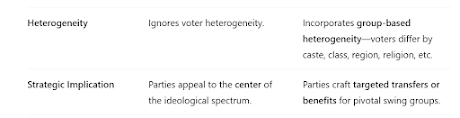
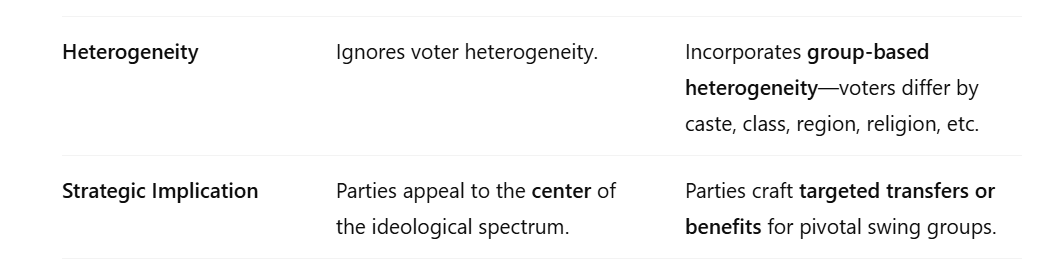
To put it in absolutely simple language, in downisian electoral politics model which says, that, voters vote for the party closest to their ideology and probabilistic voting model, which basically says that, voters choose their winning candidates based on factors like - ideology, charisma of a candidate, narratives, anti incumbency to name a few. More on the different electoral voting systems can be found in the images attached below, before we proceed onto the case study. The article will use a very limited version of the entire theories.

Basic comparisions


The implications


One of the biggest critcisms towards economists directed by social scientists is about the lack of application in real life, however,during the course of the article on this blog, it would be very much clear that some aspects of the theory definitely holds true in practice in the case of Karnataka.

Introduction On Karnataka-

Karnataka is a state located in India's south-western region. The land area of the Karnataka state is estimated to be around, 191,792 square kilometers. As per the census of 2011,the state of Karnataka has a population of almost around 6 million and has a population contribution of around 5% to a country like India, which has a massive population of 1.4 billion. The coastline of the state is around 320 km. The census of 2011 actually pointed out to the population distribution to being as the follows. The economic contribution of Karnataka sector wise is - Agriculture(16%), Industry(20%) and Services(64%), which will become a very very crucial factor in analysing the political climate of the state in this particular article. Karnataka's per capita income is at Rs. 3,80,906 and the overall poverty rate of the state is at 20.91% , which play an important role in deciding the outcomes of 28 Lok Sabha seats. Karnataka has a bicameral legislature at the state level which means, the state has a legislative assembly and legislative council. India follows a first past the post system and a parliamentary form of democracy, in which every province contributes some seats.

Understanding Karnataka Politics

The 28 Parliamentary Segments of the state 


The graphs have been attached after 3 paragraphs.

The ruling party of Karnataka, today, is Congress and opposition is BJP ,with the third largest party in the state which has polled around 5-6% votes is the JDS(Janata Dal Secular). There are 28 Lok sabha seats in the state. All the Lok Sabha parliamentary constituencies in Karnataka have 8 vidhan sabha segments in it. The state of Karnataka though has some unique political preferences which make them unique, just like every other Indian state.

In the province or state level election, Congress party in the state has generally won around 38% of the vote share, throughout decades , whereas the Bharatiya Janata Party since its rise in the late 1990s has consistently won around 36% vote share, except the 2013 as shown in graph number 2, for which a prime reason was the tall & respected leader BS Yedyurappa left the BJP and formed the Karnataka Janata Paksha which subsequently merged with BJP in 2014. However, the most interesting factor is that, even before the Modi wave in 2014, from 2004-14, the BJPs vote share in the Lok Sabha elections is consistently hovering between 40-42% in the national level election and the state level election has tended to reduce. 

Now, when, the numbers in vote share are only compared(though its not the gratest of indicators to use in a FPTP system), at the state level elections, Congress has tended to surge ahead while BJP has stayed back, which actually provides a justification as to why BJP-Karnataka has never won a simple majority on its own in the state. However, when the national level figures, have been compared, it can be easily and aptly seen that, Karnataka has always preferred the BJP over the Congress, which is also prevalent in the electoral history of the state, as the BJP has consistently won at least 17 seats out of 28 in the state. Meanwhile, Congress's vote shares have declined in this time frame in the Lok Sabha elections if seen in the first graph.
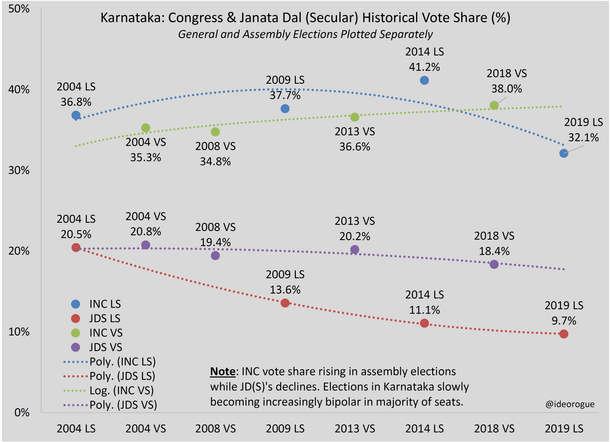
Swarajya - Congress & JDS Vote Share (Graph 1)


We can see, that Congress party is a major dominant party in Karnataka, with a much consistent vote share in both parliamentary and state elections, which is primarily due to the first movers advantage they had in the 1951-1967 period, the advent of tall leaders like Devaraj Urs, SM Krishna, S. Nijalingappa, Veerendra Patil amongst others led the party during the phase where Congress was mostly the sole ruling party in the center and the leaders bought in different sections of the society, which strengthened them on the ground level. The advent of strongmen leaders continued in the Congress, with the further rise of DK Shivakumar and Siddaramaiah. 

The third party which is completely underrated in most of the analysis is the Janata Dal (Secular) of the former prime minister of India, HD Dewe Gowda. It can be seen, from the first graph that, the JDS is a declining but still a potent force as it polls around 10% vote share in the state. Their criticality can be simply understood by 2 factors of - When, the difference between 2 major parties is not even in double digits any political person with a double digit vote share can flip the results as India follows a FPTP system, which in simple terms says, that anyone who has more votes can win the election in such a case, whose votes is the third party actually taking becomes interesting to see. The second factor, as to why, JDS is important for the state politics can be gauged by the fact that, in 2019, the Congress-JDS combine took on the BJP and in 2024, the JDS-BJP combine took on the Congress in the Lok Sabha elections.  

But, JDS has never contested an assembly election with either of them, as maybe they would be vary of the future existence of their party. The JDS party is a technically a Pan-Karnataka party, but, its majority of the legislators have come from the Old Mysore Region and Central Karnataka which account for almost 100 Vidhan sabha seats out of 228 Vidhan Sabha seats, whereas Lok Sabha seats are almost around 12/28, which makes them critical in the fortunes of the state politics. So, even, JDS is a major powerplayer in the state and even if they are not major players in the national politics, but their fortunes can change a lot of dynamics.
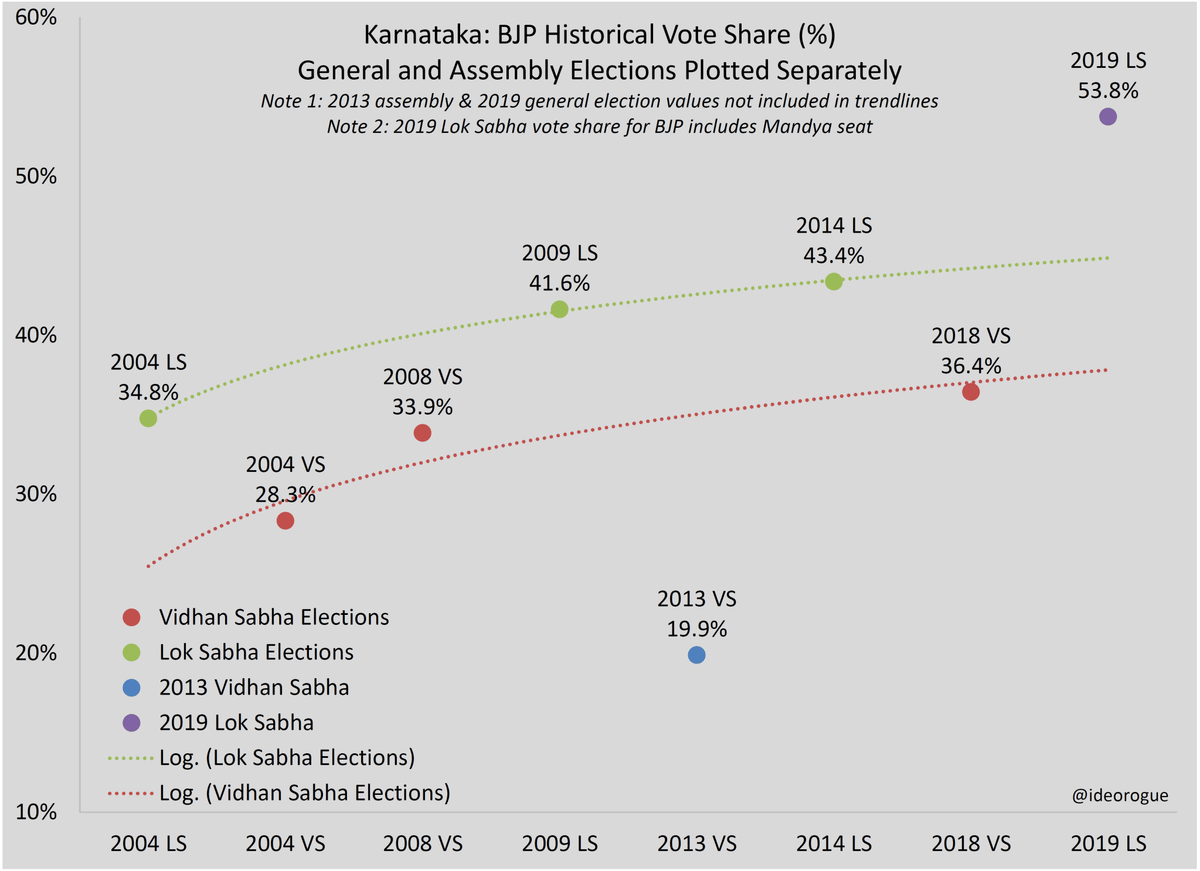

BJPs vote share in the state (Graph-2)

In fact, as per many political observers of India, the fall of JDS in Karnataka and the rise of BJP in Karnataka are correlated, as both of these parties were formed on anti Congress planks. Even, the history of both of these parties are correlated, as, both of them came in from the now defunct Janata Party(merged with the BJP in 2013) which was formed in the aftermath of the emergency imposition by Indira Gandhi in 1975. The Janata Dal Secular, itself is a faction of the various Janata Dal mergers and acquisitions that occured in Karnataka over the years, with the most significant one being the breakaway faction of Janata Dal which merged with the BJP in 1996 which was engineered by former CM Ramakrishna Hegde. The interesting history of JDS can be accessed here.

Basic Takeaways -

The first graph is of the congress-JDS vote share and second graph is of BJPs vote share. 

The overall picture as to how the, electoral voting theories are applicable in Karnataka are based on 3 results -
1. The Downisian Electoral Voting which says, that, people vote on particular ideologies is true in the case, which has been proven via the incredibly consistent vote shares of both the parties.
2. The MPVT which explains people's biases, which explains as to why the extra 3-4% voter prefers BJP over Congress in the Lok Sabha election, some reasons which would be explored under the article.

The Wonderful Tale Of Karavalli Karnataka

1. Karavalli Karnataka : This region of the state has given legends like Rani Abbaka Chowta of Ullal along with being host to some of the biggest Hindu cultural iconic sites in India namely, the Kukke Subramanya Temple, Udupi SriKrishna Temple, Shravanabelagola, Dharmasthala, Hornadu, Shringeri amongst others. In fact, Adi Shankaracharya set up one mattha of Hinduism in Shringeri, which was meant for promotion of Hinduism. Karavalli Karnataka also has a lot of places of Christian, Jaina and Muslim importance like - Rosario Cathedral, Infant Jesus Shrine, Ullal Dargah amongst others. This is called as the coastal belt of Karnataka. 

The coastal belt of Karnataka is called as the most politically charged region of the state. The region has 3 lok sabha seats of - Uttara Kannada, Dakshina Kannada and Udupi - Chikamaguluru. Currently, all these 3 seats are being represented by Bharatiya Janata Party consistently from the past 3 elections. The major communities in this part are namely, Bunts, Bilavas, Mogaveeras, Vokkaligas, Lingayats, Kurubas, Brahmins, Jains, Muslims & various artisan and fishing communities, amongst others who are also crucial.

The 3 coastal districts of Karnataka


One interesting seat, worth analysing, which fits perfectly in the probabilistic voting theory is of Dakshina Kannada, though every other seat can also satisfy the theory to an extent. Dakshina Kannada has Mangalore city in it, which coincidentally is the second largest contributor to Karnataka's state GSDP, it actually accounts for Rs. 1.25 lakh crore in FY-2023 as per the state economic survey and contributes to 5.5% of the state's GSDP. This urban nature of the seat, is a prime reason, why the Bharatiya Janata Party, has won from this seat, almost consistently since 1989. This also fits right into the given model of probabilistic voting theory.

For starters, Bharatiya Janata Party, before the Modi era of 2014 was called as a majorly urban party in the country, which was also true till an extent for Karnataka, though there is ample number of evidences like BJP winning predominantly rural seats in the state. 

Dakshina Kannada also has a very strong ideological presence of the Rashtriya Swayamsevak Sangh(BJPs ideological mentor) in fact the current Secretary General(Organisation)  of BJP is BL Santosh, who has grown  up from the current RSS system in this particular region. Along with it, the BJP has had a battery of leaders from this seat in the past, which included the former state BJP president of Karnataka BJP Naleen Kumar Kateel, the current MP Captain Brijesh Chowta, former CM DV Sadananda Gowda who have kept the BJP in a dominant position in this place.

The same story can be said about the other 2 seats namely, Uttara Kannada and Udupi Chikamaguluru, in which BJP had leaders like, U. Chittaranjan, Anant Kumar Hegde who have won this seat for BJP very consistently since years.

Hence, it can be said, that probabilistic voting theory is absolutely perfect in the Coastal belt of the state, as candidate loyalty along with ideological base and organisational strengths have influenced the results to be in favour of BJP.

Another factor, that gets, counted in here, is that, the region has given BJP its Member of Parliaments, before other parts of Karnataka started moving towards the BJP in 1999, which was partly due to the Hubli Idgah Maidan Issue and the Ram Janmabhoomi Andolan amongst other factors, which are mentioned above. 

Identity Politics in Karavalli Karnataka :

The coastal belt of Karnataka has a very subtle and a different composition which plays a crucial role in their politics. The caste composition of  these areas is a mixture of various social groups like - the socially dominant Bunts, the Bilava OBC group, Brahmins who have traditionally been BJP supporters. Muslims & multiple obc groups who have traditionally been Congress supporters in the past. 

Though on a general scale in Karnataka, major groups like - Brahmins have supported BJP, Lingayats have supported BJP, Bunts have supported BJP, Left Hand Madiga Dalits have supported BJP, OBC communities like and a good section of Nayaka Valamiki Community(found in Kalyana Karnataka, classified as ST)have supported BJP.

Though, none of the issues in any of these communities are the same and neither is their support completely identical. Panchamashali Lingayats(a sub sect of Lingayats) have agitated against the BJP when a powerful BJP minister from Kalyan Karnataka, named Murgesh Nirani who was sacked from his post in the early 2020s.
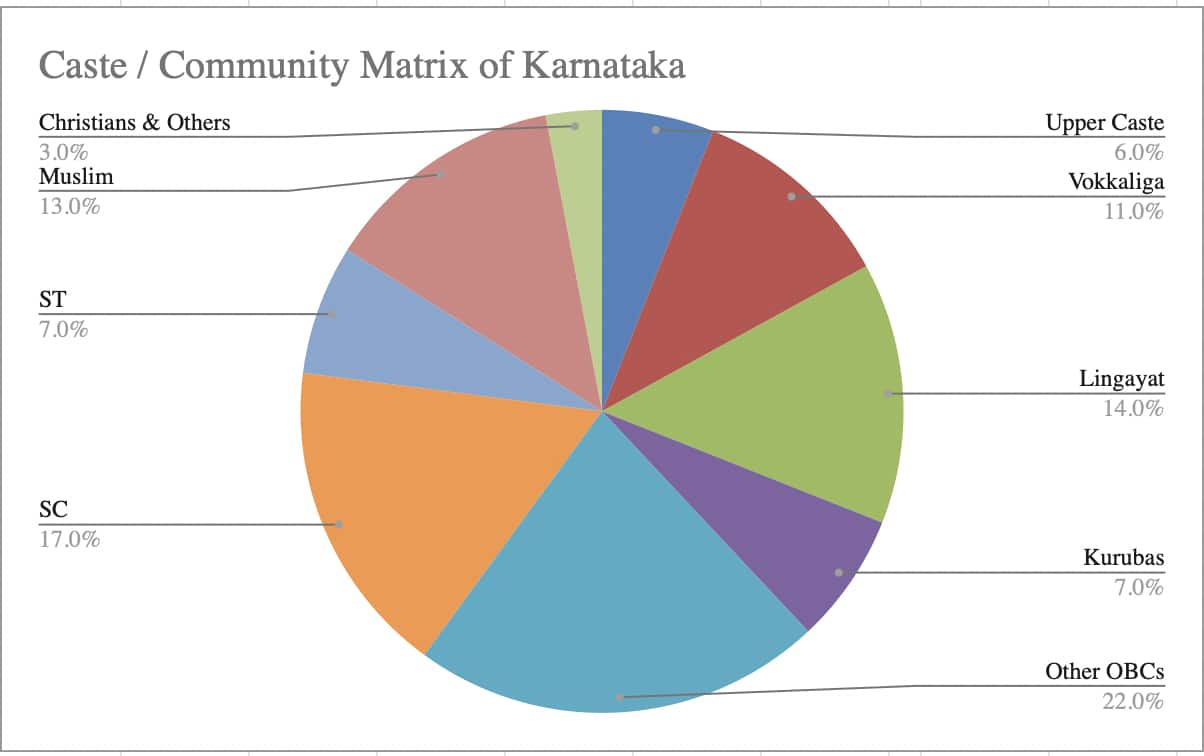
The general community matrix of Karnataka, as per NSSO 2015


The coastal belt of Karnataka has also been a hotspot for communal tensions with both the dominant parties blaming each other for the various number of communal instances (like the brutal murders of  Prashant Poojary& Muhammad Fazil, who belonged to Sangh Parivar{BJP} & Congress respectively) have occured in this region.

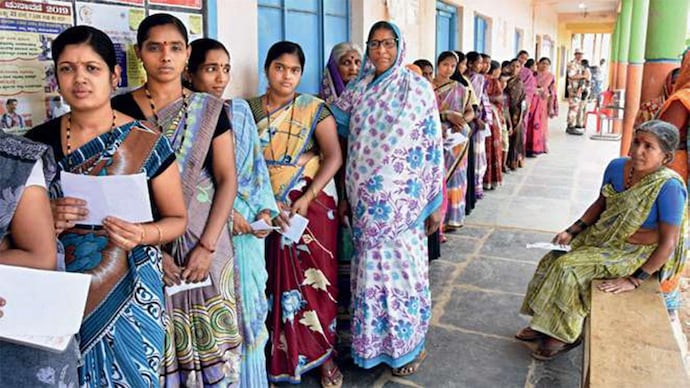
Along with these issues, there are other issues which impact voter behaviour which are - Tulu language identity, infra decline, economic neglect and lack of preserving the cultural identity of this particular region. All these issues are crucial during narrative building, which becomes part of MPVT.


Also anti-incumbency  onto the candidate in these places is always high, which was seen in the election result of a Vidhan Sabha segment named Puttur seat, where the political sidelining of Arun Putilla(a tulu hindutva activist) by the BJP, ended up contesting as an independent, which  led to the Congress party winning the seat which is otherwise considered a BJP stronghold.

This validates the MPVT theory discussed before and even the Downisian electoral theory which says, that, if an ideologically inclined voter does not get his/her choice of candidate, bias kicks in and they may vote for the other candidate. The case of Puttur where, Mr. Ashok Rai won proves this case. Picture attached below for reference.

Puttur Vidhan Sabha result. The independent candidate who was a ex-BJP leader ended up denting his own party.


However, despite such a polarized state of electoral politics, the Mangalore Port is the 7th largest seaport in India and the port handles 75% of India's cashew & timer exports, along with hosting major companies like Cochin Shipyard, KIOCL and BPCL to name a few, which proves the single peakedness theory true, which says that, despite parties with diverse ideologies coming to power in the state, they would converge to a median level of policy which becomes indifferent to ideologies.

Gender & Nepotism, its link with electoral theories:-


The sex ratio of the Karnataka state is at 973 females per 1000 men,the median in the country was at 943 as per the census 2011 , which partly to an extent shows the impact of the educational & women-oriented  reforms enacted by the Wodeyar Dynasty especially during the reign of Nalawadi Krishnaraja Wodeyar whose reign lasted from 1919-1939, in this case, Karnataka had a headstart where even in 1951 Census whereas, Karnataka's sex ratio was 946.  This author had authored an article on the king which can be accessed here.

As per the census 2011, the urban population in the state of Karnataka is estimated to be around 38% whereas the rural population of the state of almost around 61.33%. The interesting part is that, the rural sex ratio as per the census 2011 is estimated to be around 978 which is significantly higher than their urban sex ratio, this partly explains why, the Karnataka Congress's promise of Gruha Laxmi scheme promising a cash incentive of Rs. 2000 had a major impact on the voting patterns in the more rural regions of Kalyana Karnataka (6 Lok Sabha seats of Bidar, Koppal, Bellary, Raichur and Gulbarga) in the 2023 election, where Congress party ended up winning around 61% of the seats on the back of this promise. Also, since the rural poverty in Karnataka is at a whopping 24.63%, this also partly explains why the Gruha Laxmi scheme became a big gamechanger in the state elections. 

This announcement comes in as a bias in the formula seen before which essentially appealed to a particular segment of women in Karnataka. This particular issue is still prevalent in Karnataka, as the former Prime Minister of India and the JDS supremo, HD Dewe Gowda also validated this point in December 2024, in his news byte. Along with the scheme itself landing in multiple troubles with accusations of corruption etc. also flowing in the same from the opposition BJP.

Though, its a very oversimplified analysis, even with respect to Kalyana Karnataka, because during this particular elections other factors like - The Loss of Lingayat votes from BJP, the formation of Gali Janardhan Reddy's(former BJP minister in Karnataka) now defunct Kalyana Karnataka Rajya Paksha, strong local candidates in Congress, demographics favouring the Congress, which again proves that, probabilistic voting theory can actually be possible when all the factors align and can influence results.

It is very interesting to observe that, though, women are economically empowered in Karnataka, but, in the past 4 Lok Sabha(Parliamentary) elections since, 2009, there have been very few elected woman MPs  who have won namely - Shobha Karandlaje(3 time MP, 2 time from Udupi-Chikamagulur and 1 time from Bengaluru North representing BJP), Prabha Mallikarjun (1st time MP),J Shanta (Representing BJP and 1 time MP from Bellary in 2009, she switched over to YSRCP in 2024) and  Priyanka Jarkiholi (Representing Congress and 1 time MP)

The same can be said about the assembly level women leadership, which is limited to leaders like Laxmi Hebbalkar from Congress who is successful in state politics. At least, amongst the woman member of parliaments, it can be seen that these leaders represent 2 diverse groups which are - self made leaders or  relatives of already powerful ministers. The latter is a particular & a peculiar factor in the context of Karnataka politics, which can be seen in the family lineages of multiple top political figures of the state, who are in the age group of 25-50.

Some of the prominent politicians in Karnataka like - Yathindra Siddaramaiah,BY Vijayendra, DK Suresh, Priyank Kharge, Nikhil Kumaraswamy , HD Revanna, Tejasvi Surya, Jarkiholi family & Aravind Bellad amongst others who are leaders from big political families.

The reason, why this phenomenon maybe true in case of Karnataka is because of the high per capita income which actually leads to a lot of expenditure in politics as a politician has a lot of incentive to get the votes of the swing voter in the state. This becomes true even in the case of Karnataka as since the 1990s, the state has never seen an incumbent bounce back to power.

This shows that the role of the swing voter is exceptionally critical in the state of Karnataka, which to an extent captures why a lot of corruption also occurs in the state politics. This particular part is a hunch of the author, which can be critiqued or questioned. Also, another reason why many prominent and high achievers politicians are from families is maybe, because of social reasons like - lifestyle of a politician, seeing the son as the heir apparent to the parent's political legacy, all factors which get captured the other factors of the theory, given in the introduction.


Conclusion

The article tries to capture the essence of Karnataka politics at a very nuanced and data based manner, in a non-partisan manner, as the main agenda of this article is to apply a nuanced economic electoral theory to a situations in real life electoral politics.

This is the prime reason, why the political history of the state cant be covered in a blog article and it is the prime reason why the politics of other regions, the caste based issues, political history of individual leaders, center-state relations etc. have not been covered in detail  in the article by the author. Even a lot of theories have been over-simplified which is not ideal, which is why this series can shall continue on this blog with respect to each and every region cum state of India, which later on maybe extended to domestic politics of other countries.


Disclaimer:-
Any misrepresentation, any misunderstanding, any factual error & any wrong conclusion is strongly regretted. 

Wednesday, 25 June 2025

PM Narendra Modi’s Croatia Visit – Analysing The Geoeconomic Dynamics


India-Croatia relations


On 18 June 2025, PM Narendra Modi visited Croatia as a part of his ongoing 3 country tour which previously included a meeting with the Cyprus president Nikos Crystodoulides and attending the G-7 meet in Canada as an observer country.

India's foreign policy historically has always prioritised Canada and Cyprus over Croatia especially in the areas of counterterrorism, economic cooperation, and national security. High-level trips to Croatia have been infrequent, despite India's consistent engagement with Cyprus, which includes PM Modi's 2019 meeting with President Christodoulides, President Kovind's 2018 visit, and EAM Jaishankar's 2022 trip. The same can be said even for India’s Canadian engagement, historically, which is trying to be back on track after the massive diplomatic fallout during the tenure of Justin Trudeau. In fact, Narendra Modi's recent visit is the first by an Indian prime minister since Croatia gained its independence in 1992, while President Kovind's visit in 2019 was the last major one, between the countries.

About Croatia -

For starters, Croatia was formed during the brutal Yugoslav wars from 1990-2001, which has been described as one of the deadliest conflicts in Europe post the conclusion of second world war. Croatia was formed in 1991 and became the first country to become independent from the former communist republic of Yugoslavia. India immediately recognised Croatian existence in 1992 and in July 1992, a mission was also set up between the two. Croatia immediately joined the NATO in 2009. Croatia is also a EU member state which it joined in 2013, apart from being a member of various international organisations like OSCE, WTO and the United Nations. Croatia and India both have the parliamentary system of democracy, but they differ in the way in which it is followed. Croatia has a proportional voting system and India has a FPTP system.

Croatia is an Eastern European country, which makes it even more crucial in global supply chains in today’s day and time, where geopolitical conflicts have taken a hit on the European economies. Croatia is at the crossroads of Central and Southeast Europe. Croatia’s northwestern neighbour is Slovenia, northern neighbour is Hungary, north eastern neighbour is Serbia with which Croatia has had troubled relations and its eastern neighbour is Bosnia and Herzegovina. Croatia also has a sealine named as the Adriatic Sea, which is the northernmost arm of the Mediterranean Sea & quite literally separates the Italian (Western Europe) and Balkan peninsula (Eastern Europe).

Croatian Economy Basics -

Croatian economy is a peculiar case study. Croatian GDP is around 8500 crores US$ as per world bank estimates. The per capita income of Croatia is around, 46,600 US$ which makes it a firmly developed country. Its GDP growth rate is 3.3% over the past fiscal year, which is significantly higher than its other European Union counterparts like – France (0.9%), Italy (0.7%), Belgium (1.3%), Netherlands (0.3%) and Sweden (-0.3%) in the same time frame.

In fact, a broader trend that has been observed in the Balkan countries which were chided for being under-developed for decades, have recorded a stronger growth rate in the past 2 years, with countries like Serbia (3.8%), Slovenia (1.7%), Slovakia (1.4%), Bosnia and Herzegovina (2.2%), which is quite antithetical to what the rest of Europe has been experiencing after the Russia – Ukraine war.

The reasons for the sustained Balkan growth rates as given by experts are, the sustained strong domestic demand along with other industries like a quick rising IT sector, Renewables, Construction sector, Automotive parts, Minerals sector and Tourism sector which have formed the bulk of the growth rates of these countries. India must take steps to improve its trade with the Balkan states as well.

The Free Trade Factor -

This visit by PM Modi is also seen by experts as a follow-up to the long-delayed India-EU FTA, whose talks began way back in 2007, which is nearing completion. Visiting Croatia—one of the EU’s fastest-growing economies—at a time when energy supply chains are strained by geopolitical tensions like the Russia–Ukraine war, gives India added leverage in the ongoing FTA negotiations. The recent declarations of MoUs regarding collaboration in industries including semiconductors, IT, renewable energy, medicines, and agriculture bear similarities to the components of a preferential trade agreement. This can be a crucial step in assisting India in comprehending the diversity of the European market. This was also reiterated by, Envoy Goel in an interview with the Tribune.

The value of India – Croatia trade balance’s value as of year 2024, stands at 248,223 US$, as per ITC website, which is a massive increase in the past few years. The Indian exports to Croatia is modest at  298 million$, in which petroleum is the top product with a value of 81.4 million$ as per the OEC. On the other hand, Croatian exports are around, 50.6 million$ with the highest value being for Scrap vessels at 5.64 million $.

The Economic Complexity score for India is 0.76 and Croatia is at 0.69. As per trade statistics, the net trade balance value in the product segments of – Ships & boats, Nuclear reactors, Pharmaceuticals, and Wood Articles have the highest trade value. The services trade between the two, is almost negligible. The MoUs therefore in the above - mentioned sector can actually end up boosting bilateral trade between India and Croatia. The digital economy sector can be a sunrise sector for cooperation for India and Croatia, as the growth rates for both the countries in the overall economy has been impressive over the years, this has the potential to improve services trade between the two.

The Egyptian Factor –

Though many experts link the visit to the IMEC project, this may be only partly true. The Israel–Iran conflict poses serious risks to Israeli port security, deterring traders. Additionally, strained Saudi–Israel ties make IMEC projections seem overly optimistic.

However, the alternative trade route involving, India – Egypt – Croatia trade route may become reality in implementing the EFTA. India and Egypt, have stepped up their engagements in past 3 years, with Egyptian president, Abdel Fatah Al Sisi being the chief guest in India’s R-Day parade in 2023 along with, Egypt joining the BRICS in recent past, showing that Egypt is a valued partner for India in the field of economic cooperation.

For the time being, this alternate trade route may be a game-changer because Egypt and Croatia both have crucial positions in Mediterranean affairs and have stayed relatively stable (politically and economically) in comparison to other nations in the region. The overall bilateral trade between Egypt and Croatia as of today stands at around, 165 million$ as per the OEC. Also, the cordial ties, between Egypt and Croatia may provide India with partners in this newer trade route which may prove to be a gamechanger in the upcoming years.

In addition, the three nations have a common heritage in the Non-Aligned Movement, which was spearheaded by Tito (Croatia), Nasser (Egypt), and Nehru (India). This could facilitate economic negotiations and build trust before the India–EU Free economic Agreement and IMEC are finalised.

However, these predictions will hold true only if cooperation among the three countries deepens, with India playing a central role. Key sectors like banking, pharmaceuticals, digital economy, labour mobility, education, and medical tourism should be targeted for bilateral or even trilateral partnerships. This approach can significantly boost India’s soft power in the Balkans and the Red Sea region—both of which have the potential to become major growth engines for their respective continents in the coming years. At the same time, India must keep doing frequent high-level visits by crucial ministers in those countries of Europe which have been overlooked for years, but may play a crucial role in the evolving dynamics of IMEC and India – EFTA.

Therefore, to conclude, the recent visit by PM Narendra Modi can actually play a crucial role in possibly forging a new trade route and possibly shifting the dynamics in one of the global geoeconomic hotspots.

Friday, 18 April 2025

India - USA PTA : A Possible Answer To Trump Tariffs

PM Modi and USA Prez. Donald Trump's meeting earlier in 2025

Recently, the whole world has been hit hard by Trump tariffs. The tariffs announced by the USA president, Donald Trump has send world economies into a spin. The tariffs have undoubtedly changed the dyanmics of relationship between USA and many countries. The biggest country, impacted by this is undoubtedly China, where a tit for tat sorts of trade tariff war has started between the USA and People's Republic of China. Trump's action of pausing tariffs for 90 days for all countries, except China, is also forcing many experts to rething their predictions, while many saying that these tariffs were bought in to undercut China's rise as a global economic power. Though, some experts argue otherwise, which is that Donald Trump would like to have trade deals with multiple trading blocs for promoting manufacturing in the USA again, while, it would take time to judge the impact of tariffs on individual economies.

The Chinese economy since, the time of the coronavirus pandemic, has seen a slowdown in their growth rates and even though, they were recovering from the past fiscal year or so, however, the USA tariffs can be a blow to their economy, given, exports to USA alone represents 2.9% of their GDP, as of 2023. Though, China has posted good numbers in the Q1 results, but it has not accounted for the economic shocks that the tariffs can potentially deliver to them, and, with an impending border standoff with India, it would be difficult for China to find buyers for its production base, which can significantly impact their economy. Though, we may see, EU or Russian exports of PRC increasing, but again the impact on tariffs on the Chinese economy is also too early to economically predict.

The one country, which is being discussed far too less in this crucial context is India, the world's fifth largest economy and most populous country of the world. Many have forgotten about India's trade policies over the past 5 years. India has launched exiting policies like, IMEC in alliance with G-20 announced in 2023, INSTC coridoor(between Russia, Iran and India), the expansion of BRICS, attempts to internationalize rupee by using bilateral trade as a mechanism, which can play a major role, in the current world context. The decisions like quickly concluding the EFTA with Liechenstein, Switzerland, the India-UAE FTA, renewed vigor in negotiations for a FTA with UK & EU etc. can actually, decrease Indian dependence on the USA with respect to its export markets. India's additonal tariffs are at 27%, with India's economic competitors like, PRC(145% and counting), Thailand (36%) etc. being slightly high.

The one factor that, most of economists have missed out is the point that India is a consumer led economy, with  exports yet to reach the peak point as of today. This makes, India's position with respect to hardcore economics different from many other Asian economies, which are export driven. For example - Vietnam, one of the country hit quite heavily by the inaugral trump tariffs have their exports contributing to almost 85% of their GDP, which is very high.

The Indian exports basket to the USA, deserves more scrutiny in such a case, as exports, do account for 22.45% of the Indian GDP today. The USA has a 18% contribution in the merchandise trade alone for India, which is again high as the, impending tariff-counter tariff cycle would affect the merchandise trade negatively. Product wise, the top -5 goods exported from India to the USA are of electrical machinery, pharmaceutical products, natural pearls, textile products, articles of iron and steel and apparel articles, all which have a positive trade balance between India and the USA. The interesting factor is that despite, multiple geopolitical tensions like Russia-Ukraine war, Israel-Hamas conflict during the past 5 years, the trade balance in these 5 product segments, has grown massively. While, India has survived from getting into a direct trade war, however, in the present scenario, where the signing of a India-USA trade deal seems difficult, given, USAs aggresive posturing may act as a spanner in this case.

India and USA in such a case, must sign a Preferential Trade Agreement which have seen a reduced impact on world trade in today's day and age. Preferential Trade agreement is often called as the first step of  trade integration. In a typical preferential trade agreement, a few goods are exempted from tariffs and free trade connotations is applied to only a select group of goods. This is in contrast to a  FTA or a customs union, which pushes for greater trade integration by covering a wider range of goods and identical policies on tax policies, custom policies etc. The latest news on Preferential trade agreements have been centered around a few PTAs between Iran and Uzbekistan, Iran- Indonesia to name a few. With increased globalization, surprisingly big ticket PTAs have gone down. As per, a research document released by WTO, almost 300 PTAs were in force in 2010 and surprisingly, only 16% of global merchandise trade happens via preferential trade agreement. The number of PTAs between 2 developing countries have seen a kinked rise from 1980 to 2010, while the number of PTAs between developing and developed countries, in addition, to between developing countries, have seen a slow increase

In general, the number of PTAs have increased between countries from 1980 to 2010, which was considered as a time marked by multiple global shifts like the 1991 war between Iran and Kuwait, China's induction into WTO, India's economic liberalization, the fall of USSR etc. which were big shifts in geoeconomics. 

Given, this backdrop, in the last few years, news and maybe the pitching of PTAs have undergone a shift, with countries focusing more on MoUs, FTAs which can be considered as a form of PTA. The news of PTAs have often flown under the radar, with countries increasing prefering FTAs or absolute protectionism. This era of the world with Trump tariffs at play, may see the revival of PTA between the countries. India and USA, have currently, set an ambitious plan of having a net trade of almost 500 billion $ by 2030, which has seen India make a surprise move of also ending duties on petroleum and ethane. 

However, India and USA must move quickly towards signing a PTA by exempting certain goods from trade tariffs. The possible goods can be the top 10 goods in terms of trade balance - mineral products, pharma products, pearls, petroleum, textile products, IT products, electronic machinery, petroleum which have a high degree of trade dependence between the 2 countries, as seen from the data of past 10 years. Signing, a PTA with the USA is also crucial for protecting, Indian interests as India's second largest trading partner is the USA. Furthermore, signing a PTA with the USA, would be in continuation with the various succesful policies between the countries like the India-USA nuclear trade deal and the increasing bilateral trade, which can significantly influence the perception of the countries between themselves. Also, India can focus massively on its labor intensive industries which can see a big success in the PTA as the highest trading goods right now, between the country come from labor intensive industries like mineral products. 

Furthermore, the PTA between India and USA, can also act as a good starting point in case the countries are interested in signing a FTA in the coming times. To add on, signing a PTA in these target areas of highest trade balance and some ambitious areas like sports goods etc. can help keep India-USA on path of having a success in the mutual bilateral trade of 500 billion$ on line.  In case, after 90 days, the posture of the White house remains the same, the PTA must be advanced during these 3 months itself. 

Additionally, the PTA can provide a blueprint to India, if it intends to sign FTAs with other countries like Brazil, ASEAN nations, Japan etc. which are crucial trading partners for India. Some examples of most succesful PTAs over the years have been of USMCA and AfCFTA, though, there are countries in the same PTAs who have argued that these PTAs were not necesarily good for the country. An important factor , that may act as a potential bottleneck for India signing a PTA with the USA, is also its experience with RCEP, from which India withdrew in 2018 on the charge of hurting its national interests.

However, India needs to significantly invest on factors that act as a bedrock for international trade, in order to make sure that India's trade competitiveness remains high in such a polarized geopolitical world. The first step can be to maybe possibly restart the concept of SEZs as promoted by the author in an old article, here also preferential treatment can be given be to states like MP, Odisha, Andhra Pradesh and to sectors like renewable energy which have a high growth potential in the country. The other long pending reform is to revive the Indian Trade Service(ITS) which has been understaffed and underutilised for a long time as per this article. In addition to these, India must also invest heavily in manufacturing sector and focus more on the China+1 policy, in addition to making sure that, enough investment in done in technologically heavy sectors like generative AI something, which was pointed out even by the current commerce and trade minister, Sh. Piyush Goyal recently which resulted in a big debate in the country. Additionally, India must invest in skilling its youth enough and improving the literacy rate in the country, as it is said that the reason why China's economic reforms of 1978 were succesful was due to having a 78% literacy rate. These factors can possibly act as a big bedrock if India, intends to make exports a major part of its economy.

All in all, the tariffs by the current USA dispensation can give a chance for India and USA to revive the concept of Preferential Trade Agreements and maybe, create a long lasting impact about world sees the power of good and cordial bilateral relations.

Friday, 31 January 2025

Can SEZs Make A Comeback In Budget 2025

Source - Investopedia

Recently, India released its  Q-3 results, which posted a 7 quarter low growth rate of 5.4%  and the GVA slowed down to 6.8% in this quarter. Multiple economists of the country, penned down these results to factors such as, reduction in exports, lack of rapid job creation etc. in the economy. In fact, the budget 2024’s main focus was on mass job creation in the economy. In India, SEZ is an innovation that created mass-scale jobs in the beginning of 21st century, maybe in budget 2025, its time for Smt. Nirmala Sitaraman to reintroduce SEZs again into the Indian economy, to give wings to India’s growth story.


The first documented history of SEZ, in India, was in the form of Export Processing Zones (EPZ) set up in Kandla in 1965. However, the EPZ policy was inconsistent and there was the license raj regime which kept the growth potential of these EPZs slow. This was replaced by special economic zones(SEZ) announced in 2000, by then India had EPZs in more than 5 locations. 


The SEZ Act was passed in 2005 May by parliament. Some of the key objectives of these SEZs as per the act were – generation of additional economic activity, promotion of export goods and services and creation of employment opportunities, being the key objectives. Since then, the SEZ Act 2005 has not been amended or changed many times. As of 13th January 2023, 270 SEZs are operational and about 64% of the SEZs are located in 5 states of Tamil Nadu, Telangana, Andhra Pradesh, Maharashtra and Karnataka.


The SEZs and its relative activities have slowed down massively in last few years with barely any budget announcements, and since 2019, with the introduction of schemes like PLI, PM Mitra Parks, Atmanirbhar Bharat fiscal stimulus etc. the concept of SEZs is no more visible even in the news. With India facing export, rural infrastructure, and job creation challenges in the last 3 quarters, economists and think tanks must ponder whether it's time for the finance minister, Smt. Nirmala Sitaraman to revive SEZs.


The SEZs as pointed out before were created to deliver high rates of growth and the areas around SEZs are usually given the best of infrastructure to fulfill the economic designs of that particular state. The last update related to SEZs was issued by the research team of PIB way back in 2021. 


As on 30 November 2021, 425 approvals for setting up SEZs have come up in the country and 8 agro food processing zones out of which 3 are functional. This was the last major news related to SEZs in the country, which was issued by the then, Union MoS for Commerce & Trade,Smt. Anupriya Patel, the Apna Dal(S) supremo, in a reply to a parliamentary query in 2021. 

As per a research by GIPE, in 2017, 81 SEZs were denotified where major reasons cited were - imposition of Minimum Alternate Tax, Dividend Distribution Tax and viability of land that was given to the corporates. To credit to the government, SEZ Act, 2019 amended the 2005 law and in 2024 SEZ Amendment rules, gem and jewelry units were allowed to source gold, silver or platinum from foreign buyers. Looking at the last few articles or the approach of the government, it seems that the government of India, is more interested in creating the SEZs as an economic zone that caters to specific industries like agro food industry or pearls instead of being inclusive to all the industries. 

This approach faces challenges, including difficulty in identifying centers within states and a lack of specialized labor, resulting in limited job creation. Additionally, sector-specific focus raises investor concerns about prioritizing high-value industries, hindering mass replication and competitiveness, as seen in sectors like civil aviation.

The third issue is that a lack of SEZs risks making India's growth story lopsided, with only states having a significant number of SEZs driving export progress, ultimately hurting the country's net trade. Currently, 64% of SEZs are in five states, and Maharashtra, Tamil Nadu, and Karnataka are in the top-3 of NITI Aayog's 2022 Export Preparedness Index. 

India's investment history shows that states with SEZs, whether industry-specific or broad, attract more FDI in the long run. Not surprisingly, states with a strong SEZ history, like Uttar Pradesh (operational SEZs since 2000, aiming for a $1 trillion economy) and Maharashtra (MoUs worth ₹16 lakh crore signed at WEF Davos), are leading in economic targets for states.

Naysayers may argue that already developed states don't need more SEZs, but the focus should shift to states like Rajasthan, Odisha, Telangana, Madhya Pradesh, Chhattisgarh, and Assam, which require a significant boost in manufacturing and export competitiveness. SEZs can attract investments and unlock these states' untapped potential as export hubs.

While, the promotion of SEZs may not have a major impact for the already well to do states, the comeback of SEZs in the lesser developed states of India would help them, to win over investor’s confidence as SEZs are the areas blessed with the state of art infrastructure liberalized trade laws and simplified labor laws. To add on, even with its challenges like inefficiencies in land utilisation, SEZs still have a contribution to almost about 34.83% Indian exports even in 2022-23. This shows that SEZs are still relevant for India’s export ambitions, in key sectors like pharmaceuticals, automobiles etc. 


To add on, given Indian ambitions of creating GIFT city for international financial institutions or the Bharat Vayuyan Vidheyak - 2024 of aircrafts manufacturing or  developing the peripheries of big cities, all these require massive investments, which can pushed forward only via SEZs in an economical way. It makes absolute sense to reintroduce the special economic zones in the states, where the respective state governments are also enthusiastic of delivering high economic growth in a short time.

With the Modi government's industry-specific approach, sectors like financial institutions, civil aviation manufacturers, and PLI-linked industries can be integrated into multiple SEZs across states. This will boost exports, diversify the economy, and drive job creation. This could be the right time to reintroduce SEZs, as India now boasts massively improved road connectivity, doubled domestic airports, and expanding high-speed rail networks, enabling seamless integration of high job-creating industries. With the pre-existing single-window clearance system in SEZs, their revival would be smooth and come with minimal economic costs for the country.

To conclude, this is the correct time to reintroduce SEZs and perhaps bring more industries covered under the PLI in these SEZs in a new avatar which will help in rapid infrastructure development in the country and improve the economy’s productivity. All it needs is a reframed and a refocused version for SEZs, which can deliver high growth rate for the country, via the Ricardian way of increasing exports.

Pingali Venkayya - An UnderAppreciated Genius Who Gave India Its Identity

AI Generated Image In, 2021 before the Indian Independence day celebrations PM Narendra Modi has launched the unique campaign, titled “ Har ...