 |
A few weeks ago, a statement made to the press by India's Commerce & Trade Minister, Piyush Goyal sent a shockwave amongst sections of geopolitical & economic observers in the BRICS countries. His statement of India not being in favor of separate BRICS currency, made a lot of ardent supporters of de -dollarization confused as to what had transpired, as a lot of them had hopes on India vigorosly pursuing the de-dollarization agenda, given President Trump is in office. Additionally, the meetup between Indian Prime Minister Narendra Modi, Chinese leader XI Jinping & Russian president Vladimir Putin has given more winds to such talks especially after the recent happenings in Iran & Venezuela.
To add on, the recent Q1 GDP growth figures recorded by BRICS founding member countries, stood at 7.8% (India), 5% (China), 0.6% (Russia), 1.1% (Brazil) & 0.5% (South Africa) has ignited major optimism amongst international economics enthusiasts about whether a common BRICS currency can challenge the dominance of US$ today. This article seeks to analyse whether a common BRICS currency can challenge the dominance of US$ and whether the countries will take this bold step which can determine the future of international financial flows.
This currency is an exciting idea, as it will bring around 11 of the world's biggest emerging economies in a common financial framework cutting across geographies which has the complete potential to make the US$ an irrelevant currency in the Global South. However, economics being the mother of all sciences, not every idea is straightforward and this article seeks to analyse the economic feasibility of the BRICS common currency via the 7 stages of economic integration as proposed by Bela Balsa in 1961.
Common Currency Background -
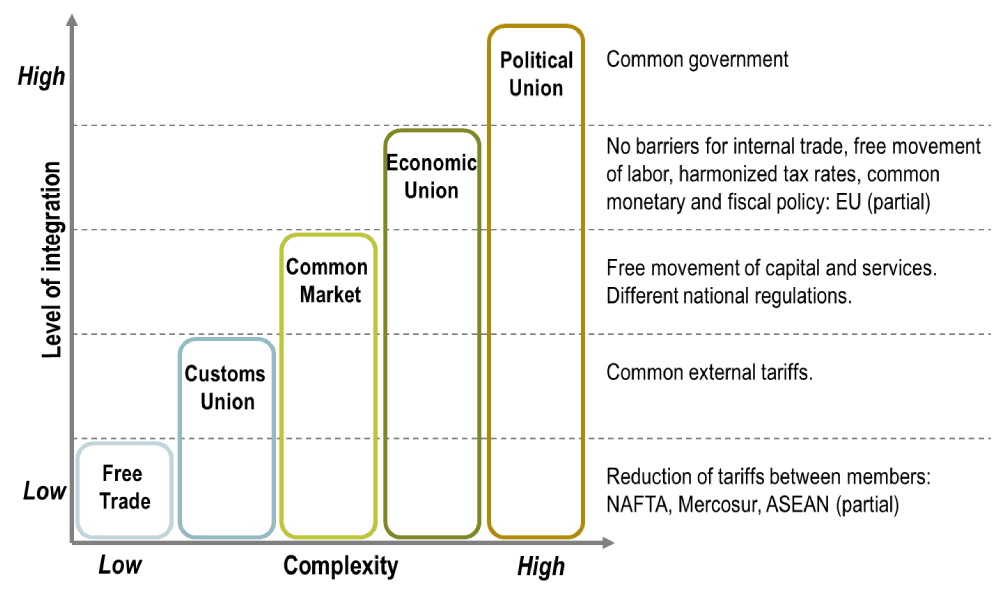
1 or more countries having a common currency is considered as one of the highest stages of economic integration. In the traditional 7 stages of international economic integration theory as given by Hungarian - American economist Bela Balassa, having a common currency forms the part of 6th stage of economic integration which is economic & monteary union, aka, currency union.
Having a currency union has all the elements of :- low tariffs amongst each other on specific goods, zero tariffs on each other for all goods & services, a common external tariff against other member states, a free movement of labor & capital between the countries, harmonization of macroeconomic policies at all levels (from taxation to trade & from expenditure to public debt) and a unified monetary policy.
Now. technically, to introduce a new currency none of these elements are actually required, however not introducing them can lead to a policy mismatch which can push such experiments to actually fail. The best intuition based example of this can be, that, say, countries A, B & C have decided to form a joint currency with very much the same economic characteristics, however, if country A decides to adopt a fixed exchange rate regime and if countries B & C, decide to adopt a floating exchange rate regime, such an effort would not be conducive as it would mean that there is a competitive exchange rate regime, which will end up diminishing the value of a currency.
Similar, economic intution also holds for a common external tariff against a third partner country, if 2 countries in an economic currency union apply the same tariff rate against the external partner, but if it differs from the tariff policy adopted by a third country in the union against the external partner, that would mean - no coordination in how tariffs are being applied, since 1 country in such a scenario is always having low tax collection that would lead to imposition of higher taxes which will mean that there is no uniform taxation policy amongst the countries in such a case naturally, the country with the lowest tax rate will end up having a competitive advantage & that would mean that, the principle of common trade benefit on which the currency union has been formed will also collapse.
Therefore, to maintain conducive economic conditions, post the formation of currency union, its imperative that the first 5 stages of integration is completely successful.
A Geographically Distantly Close Problem-
 |
| The economic strength of BRICS+ |
The success of a currency union not only depends upon political factors, but it also depends massively upon how the economic factors of countries are at work. One of the key underrated economic factors is geographical distance.
Geographical distance, has a direct impact on factor mobility (both labor & capital), iceberg costs & trade policy that a country wants to adopt vis a vis its partner countries in the currency union. Now this is a major fact that has an outsized impact on the economic relations between countries in the context of currency union. To have a successful currency union, the geographical distance needs to be in close proximity (subject to less political risk) as it influences trade.
This is the prime reason, why, all the existing currency unions in the world, today - the Euro (between 21 member states post the 1992 treaty focused majorly on European Union), Eastern Caribbean Currency Union {EECU} (between 8 island territories), West African Economic & Monetary Union (8 West African countries pegged to Euro) & Central African Economic & Monetary Community (used by 6 central african countries pegged to Euro). Some other informal agreements, are - Swiss Franc (between Switzerland & Leichtenstein), South African Rand (linked with economies of Eswatini, Lesotho & Namibia) and Australian dollars (used across countries in Oceania).
Now, if the BRICS common currency, indeed wants to be successful, then it would mean executing key connecting infrastructure projects at a breakneck pace. Executing key infrastructure projects without major cost overruns, would mean improved factor mobility, which will eventually lead to forming of a conducive environment under which the proposed currency union can be a major success.
This is where, the BRICS is lacking today - though projects like INSTC (including BRICS nations of India, Iran & Russia), Vladivostok - Chennai Maritime Coridoor (connecting Russia & India) & Belt Road Initiative, has been announced, however, the work over these projects has remained slow. Additionally, there is no clarity of how the NDB also abbreviated as BRICS Bank, is supporting these intra BRICS infrastructure connectivity projects.
Furthermore, the constant geopolitical tensions in the region of West Asia, which includes crucial BRICS+ member states like Iran and UAE, acts as a spanner in reducing geographical proximity between member states via the method of infrastructure development. Also, the other major problem here, is conflicting opinions about inter country infrastructure projects like - India & China have serious foreign policy problems over the BRI scheme.
The way forward for BRICS nations is to have common infrastructure projects, which can be executed with less cost overruns & with low political risk. The first step here can be to expand the membership of BRICS to Central Asian Region countries who can be the link between the RIC grouping and who will also benefit economically, between the coming together of the 3 biggest Eurasian economies.
 |
| RIC grouping which is the heart of BRICS |
The King Of All Factors "Inflation"
:max_bytes(150000):strip_icc():format(webp)/european-sovereign-debt-crisis.asp-final-123d9b8ce1cb43c3bb35f8a2cc8ee321.png)
Inflation, is the second major factor, that will decide the success of a currency union if it eventually happens. Inflation is the most important factor in deciding monetary policy, its importance can be gauged by the fact that, central banks adopt 2 distinct monetary policy choices namely - commitment & discretionary.
To have a succcessful currency union, its necessary that, the inflation control mechanisms between central banks are similar. This is best illustrated in the case of Euro. The Euro was formed on the back of the Maastricht Treaty, which essentially asked the countries to have price stability, public finances, long term interest rates & exchange rate stability, this was designed to majorly have compatible macroeconomic fundamentals. In fact the Euro currency is managed by the European Central Bank headquartered at Frankfurt.
Now to ensure, all the 4 factors for similar macroeconomic fundamentals, this means that, the monetary policy of countries has to be changed in a massive manner to make sure that factors like exchange rate stability & long term interest rates are similar across the 10 member BRICS+ grouping. This would eventually lead to less interference by the national central banks to manage their economy, which none of the 5 geopolitically powerful nations like BRICS will agree to.
In fact, in order to get to the formation of a common currency, it would mean that the independent monetary policy stance is sacrificed in the international trilemma theory, which is just not possible as at one point, both independent monetary policy and exchange rate stability cannot be sacrificed, for free capital flows, that would lead to huge financial instability which is not conducive for economic growth.
Additionally, an important factor that geopolitical enthusiasts miss out is that, all the 5 BRICS+ countries are emerging economies and 1 trait of EMDE monetary policy is having an independent monetary policy. This has been seen repeatedly in the context of many countries over the past few years, hence having the idea of 10 EMDE countries sacrificing independent monetary policy & exchange rate stability, is a cruel economic shock which would set development in these countries behind by many years.
Furthermore, there is always a risk of borrowed inflation & an engulfing debt crises, in case of currency unions, which has been seen repeatedly in EU economies. The peak of which was seen in the 2009 - 10 Eurozone sovereign debt crisis. Now any currency union like the Euro (which is a longstanding successful one) has 2 set of countries, one core economies & another one being periphery economies. Core economies are those which have a bigger economic size and periphery ones are those which are newly expanding or say are EMDE or LDC countries. In 2009 - 10, debt crises, what happened was interesting, where the ECBs interest rates led to high savings & capital outflows in core economies like Germany & Spain, while the peripheral zone saw cheap borrowing leading to credit expansion leading to consumption boom leading to huge current account deficits and then eventually a debt accumulation, all within the space of 1 year.
This is a very real economic risk in the case of BRICS+ grouping, as it would be very difficult to decide which is a core economy or a periphery economy and if there are more countries joining in the agreement (if signed), there would be a looming debt crises which can have huge impacts on the growth rates for all the partners. This would mean, that, the countries even if they want cannot leave the currency settlement, as their home central banks have been heavily weakened & that would mean a complete breakdown of monetary policy making. If the countries, choose to stay on they will be posting laggard economic growth, which is again not beneficial for EMDE+ countries to say the least.
_-_centered.png?utm_source=en.wikipedia.org&utm_campaign=index&utm_content=thumbnail_unscaled) |
| Representation image |
Inflation differential rates is one of the most underrated factor in a currency union. The monetary policy in the case of a currency union is determined by the base factor of the economic size of the countries, this has its own complications as no 2 economies can ever have the same economic size though they may have the same economic characteristics. This is the precise problem what European economies have faced as the ECB rates means differently for a high growth country (Spain) & for a low growth country (Germany). This leads to a inflation differential problem.
For example - the nominal ECB rate is at 3% & German inflation rate is at 1.5% that makes the Real Interest Rate at 1.5%, however, Spanish inflation rate is 3.5% which pegs the Real Interest Rate at -0.5%. This means, that Spain experiences a much looser monetary policy, which will improve Spanish economic power translating into geoeconomic gains, as they can invest heavily in exports. This would mean that 1 partner will always have an unfair advantage vis a vis the others. This inflation differential problem is yet another reason, why the idea of common currency for BRICS+ nations who need controlled inflation to post good growth results, will struggle to establish a common currency.
Furthermore, having a huge inflation differential which the EMDE countries would want to have for some time to support high growth rates, this will actually lead to price instability in the currency union, this would also result in difficulties in setting up a benchmark interest rate which can lead to a currency or asset bubble, which can have a stagflation effect on the economies. Furthermore, having a common currency would also mean having common asset markets and a common peg against the gold as a reserve currency which is against subject to exchange rate volatilities that would result in greater financial instability in these EMDE countries in the longer run.
The Background Work -

The Euro has been taken as a comparision yardstick as its the only currency union that exists between 10 or more than 10 big economies, which is precisely what BRICS+ would mean today, given their massive economic strength today where in terms of GDP (PPP) they are way ahead of G7 and in terms of petroleum production they are undoubtedly the highest in the world.
The background work in the currency union is the most crucial thing that can decide whether it can sustain geoeconomic changes or not. Now, prior to the formation of the Euro, there were a spate of agreements between different member states (which can be found here) - Treaty of Rome (1957), Werner Report (1970), 1972 Snake in Tunnel which had exchange rate bands for countries, 1979 which had managed exchange rate regimes, 1986 capital liberalisation treaty, 1989 Delors Report which had a blueprint for EMU and eventually the Maastricht treaty of 1992. Now, this corresponded to a background work of 35 years in the Euro case, which made the European economies in a structural sense as a mirror image to each other, which made it easy to implement the treaty and sustain it. This is despite countries having a different political system, however the idea of EMU was preserved for 35 long years which is the reason why it became a major reality today.
If the BRICS+ grouping really wants to have a BRICS common currency down the line from today, it must need to make the economies structurally similar to each other. This would mean, a lot of reforms need to come through in all the 10 economies, just a small example here can be of the workforce hired in the agriculture sector of these nations. India hires 45% of its workforce in agriculture, Ethiopia hires more than 60%, Egypt hires more than 20%, Indonesia hires 25%, China hires 25%, Brazil hires 8%, South Africa hires 5%, Russia hires 7%, Iran hires 15%, Saudi Arabia hires 3% and UAE hires less than 2%. This means, the gap is enormous when it comes to the structural issues for all the 11 economies. They would need to work for a long time to make sure that, the economic structure remains the same, so that one country doesnt face the brunt of a currency union. And the work needs to be in close synchronization, and not as a competition.
The similar backgound work extends to other factors like having similar exchange rate regimes (all BRICS+ countries have a huge difference) & having the same goal of de - dollarization as that is the common thread that binds the countries today.
Conclusion -
If in case, the background work happens, what will the status of BRI by China be, will India keep its Rupee Internationalisation dream on hold, will Russia increase its oil production in accordance with the interest of BRICS+ nations, will geopolitical rivals like Saudi Arabia & Iran sign a FTA, will South Africa sacrifice its South African Rand dominance in Lesotho to adapt to a new currency, will UAE find a way to increase its agriculture workforce, will Indonesia bring in other ASEAN+ economies to the BRICS+ currency fold and will the war torn African continent join hands to have common policies against de - dollarization, is a question that must be answered by the policymakers of the world.
To conclude, the dream of a BRICS+ currency is exiciting from a political perspective, but it will require huge amounts of policy (both monetary & fiscal) synchronization between countries before the currency is launched and it would also mean a lot of geopolitical capital should be invested before such a major upheaval step is launched in the global financial market. All the 11+ expanding members of BRICS+ will need to reach all the 6 steps of international economic integration before the BRICS currency formed on the ideals of Global South solidarity is formed.


